For the past three years, Big Tech has pitched business owners a seductive promise: artificial intelligence will handle your busywork, draft your proposals, organize your receipts, and coordinate your calendar.
Yet for most business owners, the actual reality looks drastically different.
Instead of an autonomous, trustworthy executive partner, they ended up with a dozen fragmented browser tabs and an escalating monthly credit card statement:
- $30/month for a ChatGPT Team seat.
- $20 to $100/month for newly launched consumer agents like Meta Muse (
muse.ai). - $36/user/month for Google Workspace with bundled Gemini AI features.
- $50/month for a customer support AI chatbot widget.
- $75/month for an AI scheduling assistant.
- $150/month for a CRM tier that unlocks "smart summaries."
- $250/month for automated workflow glue like Zapier or Make.
Before long, a modest 5-person company is hemorrhaging $1,000 to $2,500 every single month in recurring subscription rent for cloud tools that don't speak to each other, frequently hallucinate, and upload confidential customer records to third-party US data centers.
While the financial waste is staggering, the deeper crisis is one of data sovereignty, business compliance, and architectural status.
When you upload client files, accounting spreadsheets, employee contracts, and proprietary pricing formulas to public cloud AI tools, you surrender control. In regulated fields—accounting, law, healthcare, commercial contracting, and wealth management—this cloud dependency violates internal compliance policies, breaches client confidentiality agreements, and creates serious legal liabilities under data privacy statutes like Canadian PIPEDA and PHIPA.
Furthermore, most tools market themselves as an "AI Employee"—an entry-level worker bee that requires constant prompting, supervision, and manual error correction.
There is a fundamentally better, more sovereign way: The Sovereign AI Chief of Staff & Central Command Hub.
An executive Chief of Staff doesn't just do tasks; they synthesize cross-functional context, triage priorities, delegate to specialists, hold persistent institutional memory across quarters, and ensure the principal's strategic intent is executed. More importantly, Kairos functions as an Operational Command Hub that doesn't just chat in a text box—it literally designs, deploys, and governs bespoke full-stack software portals and compliance hubs tailored to your exact business.
Instead of renting slices of cloud software from Silicon Valley landlords, forward-thinking businesses are deploying dedicated, private AI appliances running on enterprise-hardened Linux machines that you physically own. Whether delivered as a turnkey dedicated appliance (from a whisper-quiet mini-PC to an enterprise personal AI supercomputer) or installed on a spare office laptop you already own, this architecture gives you an autonomous digital Chief of Staff that operates 24/7 on a proven, rock-solid operating foundation. Because Linux powers 90%+ of the world's cloud servers, financial banking mainframes, and top 500 supercomputers, running on a Linux machine you own guarantees uncompromising reliability, multi-year uptime without forced automatic reboots, kernel-level security, strict business compliance enforcement, and $0 in recurring subscription fees.
Here is the complete blueprint of how it works, why competitors like Meta's Muse, Google Workspace Gemini, Anthropic's Claude Desktop, and developer CLIs fall short for real-world businesses, and how you can deploy true AI sovereignty today.
1. The Real Estate Analogy: Tenant vs. Property Owner
To understand why renting AI software from cloud providers is an operational trap, compare it to commercial real estate. When you rely on third-party cloud subscriptions, you are paying indefinite rent to occupy someone else's digital real estate. When you run a sovereign appliance, you own the building.
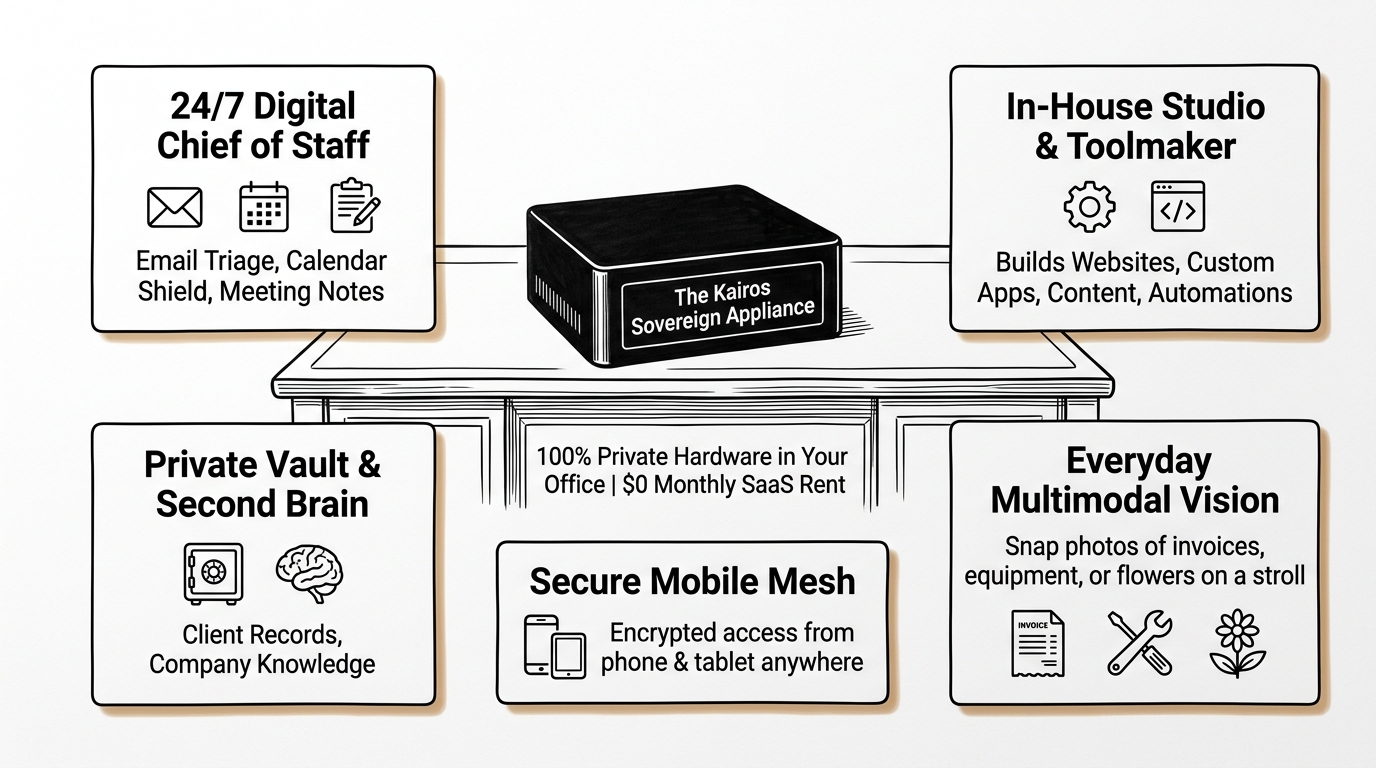
| Operational Dimension | The Cloud SaaS Model [ COMMERCIAL TENANT ] |
The Sovereign Appliance [ PROPERTY OWNER ] |
|---|---|---|
| Data Custody & Privacy | Third-Party Custody Customer phone numbers, pricing sheets, and emails reside on Big Tech data centers in foreign jurisdictions. |
100% In-House Vault All databases, emails, and client records stay encrypted on your physical hard drive behind your firewall. |
| Business Compliance & Policy Enforcement | Vendor-Imposed Rules Cloud providers dictate content moderation, data retention, and terms of service. Policies change without recourse. |
Absolute Business Compliance Your internal corporate handbook, legal duties, and compliance rules are hardcoded into deterministic ledgers and local system boundaries. |
| Legal & Regulatory Compliance | High Compliance Risk Transmitting confidential client records to US cloud servers risks breaching PIPEDA, PHIPA, and professional privilege. |
Statutory Peace of Mind Zero external telemetry. Canadian data residency and client confidentiality agreements are preserved automatically. |
| Pricing & Terms Control | Landlord Dictates Terms Big Tech can raise subscription fees, change service terms, or deprecate features overnight. |
Total Sovereign Control You own the code, database, and local models. Zero surprise rate hikes, usage caps, or API limits. |
| Outage & Blackout Resilience | Fragile Cloud Dependency If your internet drops, Wi-Fi glitches, or cloud APIs crash, your entire operation stops. |
Air-Gapped & Resilient Runs on your machine's processor; continues searching files, processing notes, and operating during blackouts. |
| Operating System & Infrastructure | Opaque Cloud Virtualization Closed-source proprietary virtualization; unpredictable forced reboots, background telemetry, and cloud outages. |
Hardened Linux Machine You Own Enterprise-grade Linux kernel on physical hardware you own. Proven 24/7 reliability, zero forced reboots, and kernel-level process security. |
| Balance Sheet Equity | Pure OpEx Expense Monthly software rent drains company cash flow, leaving zero lasting asset equity. |
Permanent Capital Asset Trained workflows, local memory banks, and operational history become permanent enterprise balance-sheet equity. |
2. The Competitive Landscape: Frontier Cloud, Big Tech Ecosystems, Open-Source Experiments, and the Sovereign Appliance
The autonomous AI landscape has evolved into six distinct categories:
- Commercial Big Tech SaaS (ChatGPT Team, Microsoft Copilot): Cloud subscriptions that rent ephemeral chat boxes, lock data into proprietary silos, and harvest company telemetry.
- New Consumer Autonomous Agents (Meta Muse at
muse.ai— Launched September 2026): Meta's new autonomous personal agent designed to handle tasks in the background across email, calendar, finances, and bookings. - Bundled Enterprise Productivity Suites (Google Workspace Gemini): AI integrated natively into Gmail, Docs, Sheets, and Meet, bundled into higher baseline subscription tiers.
- Single-Session Frontier Tools (Anthropic Claude Desktop): Impressive reasoning engines that remain tethered to the cloud and shut down when laptops close.
- Open-Source Autonomous Agent Frameworks (Nous Research's Hermes Agent): The brilliant, pioneering open-source community experiments that proved local-first, persistent autonomous daemons are possible.
- The Sovereign Enterprise Appliance & Command Hub (Kairos): The hardened, turnkey business hardware and software appliance designed for non-technical leadership, strict business compliance enforcement, zero-trust air-gapped security, and the autonomous creation of custom operational UI hubs.
The New Challengers: Meta Muse (muse.ai) and Google Workspace Gemini
In late 2026, two massive tech giants made aggressive plays to capture the autonomous assistant market. Understanding their fundamental trade-offs explains why neither delivers true operational sovereignty for commercial enterprises:
1. Meta Muse (muse.ai)
Launched in September 2026, Muse is Meta's personal autonomous agent accessible via muse.ai and mobile apps. It attempts to break free from passive chatbots by actively browsing the web, managing calendars, and handling bookings in the background.
While impressive as a consumer experiment, deploying Muse in a commercial business introduces three catastrophic liabilities:
- The Meta Surveillance Paradox: Meta's core business model is behavioral advertising and data aggregation. Handing over your company's supplier invoices, employee discussions, pricing strategies, and customer contact lists to Meta’s cloud infrastructure represents an unacceptable corporate risk.
- The "Human Contractor" Privacy Leak: Investigative reporting revealed that Meta has tested and deployed human contractor layers behind the scenes to complete real-world tasks (such as phone calls and complex reservations). For a law firm, medical clinic, or accounting practice, having an anonymous third-party contractor listening in or viewing client data violates solicitor-client privilege, PIPEDA, and HIPAA regulations.
- Consumer Task-Doer vs. Enterprise Command Hub: Muse is designed for consumer chores (booking a flight, finding a restaurant, tracking personal gym goals). It has zero capacity to build, deploy, and govern dedicated operational business portals, calculate statutory mixed-age ratios, or balance corporate ledgers.
2. Google Workspace AI (Gemini for Business / Enterprise)
Google transitioned its AI strategy by bundling Gemini directly into standard Google Workspace plans (such as Business Starter, Standard, and Plus), driving up the baseline seat cost for every company employee.
While convenient for drafting a quick email in Gmail or creating a slide deck, Google Workspace AI falls short of an autonomous Chief of Staff:
- Cloud Jurisdiction & The US CLOUD Act: Regardless of Google's enterprise confidentiality pledges, all data processed by Gemini traverses Google’s global cloud infrastructure. Under the US CLOUD Act, US federal authorities can compel data production regardless of where data is hosted, creating serious compliance friction for Canadian enterprises under PIPEDA, PHIPA, and Quebec’s Law 25.
- Sidebar Assistant vs. Autonomous Supervisor: Gemini in Google Workspace is a reactive formatting assistant. It sits in a side panel waiting for you to click "Help me write". It cannot execute 24/7 background cron daemons, monitor file directories on local disk, survive commercial internet blackouts, or run custom open-weights models.
- Indefinite Subscription Rent: Every single seat requires ongoing monthly payments to Google, leaving your balance sheet with zero owned software assets or proprietary operational models.
The Open-Source Pioneer: What We Learned from Hermes Agent (Nous Research)
Kairos stands on the shoulders of the monumental open-source achievements pioneered by Hermes Agent (developed by Nous Research).
Hermes broke free from ephemeral chat sessions, proving that an autonomous assistant must operate as a persistent, 24/7 background daemon. More importantly, Hermes introduced the concept of autonomous self-improving skill creation—where an agent inspects its own execution, generates new specialized skills from experience, and refines its capabilities over time across multi-layered memory systems.
Why Open-Source Developer Frameworks Fall Short for Real-World Businesses
While Hermes Agent is celebrated by developers and AI researchers, deploying it in a commercial enterprise introduces critical operational vulnerabilities:
1. The DIY Developer Barrier
Hermes Agent is a developer-centric code repository. It requires setting up Python environments, compiling local dependencies, managing API keys via bash terminals, troubleshooting package conflicts, and maintaining Git repositories. If a library deprecates or a daemon crashes, a busy business owner, medical director, or lawyer is completely stranded. They need an appliance that works out of the box, not a coding hobby.
2. Flat Markdown Files vs. Relational/Vector Precision
Developer frameworks store memory predominantly in flat Markdown files or simple JSON stores.
While human-readable, flat files collapse under business workloads:
- You cannot perform exact accounting reconciliations, track 30-day invoice expirations, or balance vendor statements using flat text files.
- Searching through 5,000 pages of legal discovery or geological drill hole assays across flat markdown files takes minutes and hallucinates facts.
- The Kairos Solution: A hardened two-tier memory architecture: (1) Deterministic Relational SQLite Ledger for mathematical precision, financial accounts, and compliance tracking, paired with (2) Sub-15ms Semantic Vector Vault for instant, citation-backed discovery across multi-year corporate archives.
3. Runaway Action Loops vs. Antigravity-Grade Execution Gating
A major risk of open-source autonomous agents is the "runaway action loop"—an agent autonomously rewriting files, executing destructive shell commands, or hallucinating customer emails without an audit trail or safety gate.
- The Kairos Solution: Kairos enforces strict Architectural Execution Gating:
- Pre-Execution Gating (
implementation_plan.md): The agent must outline its planned changes and obtain explicit operator approval before touching core records or code. - Post-Execution Verification (
walkthrough.md): Every action is verified with diff blocks and test passes. - Zero Permanent Deletion Policy: Deprecated records, old policies, and legacy data are archived into
legacy/vaults rather than erased, ensuring an immutable audit trail (events.jsonl).
- Pre-Execution Gating (
4. Turnkey Hardware Packaging & Scaling to Personal Supercomputers
Developer frameworks do not provide turnkey physical hardware, white-glove setup, or structured hardware tiers.
- Kairos is delivered as a turnkey appliance: from a Budget Sovereign Starter (starting from $1,000 + hardware), to an Air-Gappable Workstation (starting from $2,000 + hardware), up to a Local-First AI Supercomputer (starting from $6,000 + setup) running on 128GB–256GB unified VRAM hardware.
The Comprehensive 5-Way Competitive Architecture Matrix
| Architecture Dimension | Meta Muse (muse.ai) [ CONSUMER AGENT ] |
Google Workspace Gemini [ CLOUD SIDEBAR ] |
Anthropic Claude Desktop [ SESSION GUI ] |
Hermes Agent (Nous) [ AUTONOMOUS CORE ] |
Kairos Sovereign Appliance [ CHIEF OF STAFF & COMMAND HUB ] |
|---|---|---|---|---|---|
| Executive Persona & Role | Consumer task helper | In-app document formatter | Ephemeral chat assistant | Background researcher | Strategic Chief of Staff & Central Command Hub |
| Bespoke UI Hub Deployment | No (consumer app only) | No (rigid Google apps) | No | No | Yes (builds & governs full-stack custom portals) |
| Runtime Persistence | Background cloud VM | Ephemeral user trigger | Shuts down with laptop | Always-on daemon | 24/7 hardened Linux daemon (systemd, zero reboots) |
| Data Custody & Jurisdiction | Meta cloud (ad surveillance) | Google US/Global cloud | Anthropic cloud servers | Host-dependent OS | 100% In-house Linux machine you physically own |
| Regulatory Compliance (PIPEDA/PHIPA) | High risk (human contractor leaks) | Cloud ToS; US CLOUD Act exposure | Cloud ToS; data transit | Manual policy scripting | Statutory hardcoded law; zero external telemetry |
| Network & Remote Security | Consumer app / web | Google account / web | Web browser / HTTPS | Self-hosted API / webhooks | Zero-trust P2P WireGuard® mesh (Tailscale PWA) |
| Memory Architecture | Opaque proprietary profile | Workspace index | Ephemeral context | Multi-layer file cache | Deterministic SQLite Ledger + Sub-15ms Vector Vault |
| Action Safety & Gating | Automated web actions | User manual copy-paste | User copy-pastes | Autonomous action loop | Gated: implementation_plan.md + verified walkthrough.md |
| Offline Blackout Resilience | 0% (cloud dependent) | 0% (cloud dependent) | 0% (cloud dependent) | Setup dependent | 100% Air-Gapped execution (Tier 2 & 3) |
| Turnkey Hardware Delivery | Software subscription | Software subscription | Software only | DIY Git repo | Turnkey appliance ($1,000 + hardware to $6,000 + setup) |
| Pricing Model | $20 to $100 / mo | Bundled per-user monthly | $20 to $30 / mo | Free code / cloud tokens | $0 monthly software rent; permanent balance-sheet asset |
3. The Superpower: Spawning and Governing Deployed Operational UI Hubs
The definitive difference between an "AI chatbot" and an Executive Chief of Staff & Central Command Hub is what happens after the strategy is decided.
A standard AI tool (like ChatGPT, Gemini, or Claude) gives you advice or drafts a snippet of code, leaving you to copy-paste it into third-party tools. Kairos builds, deploys, and governs living business software tailored to your company's exact operational DNA.
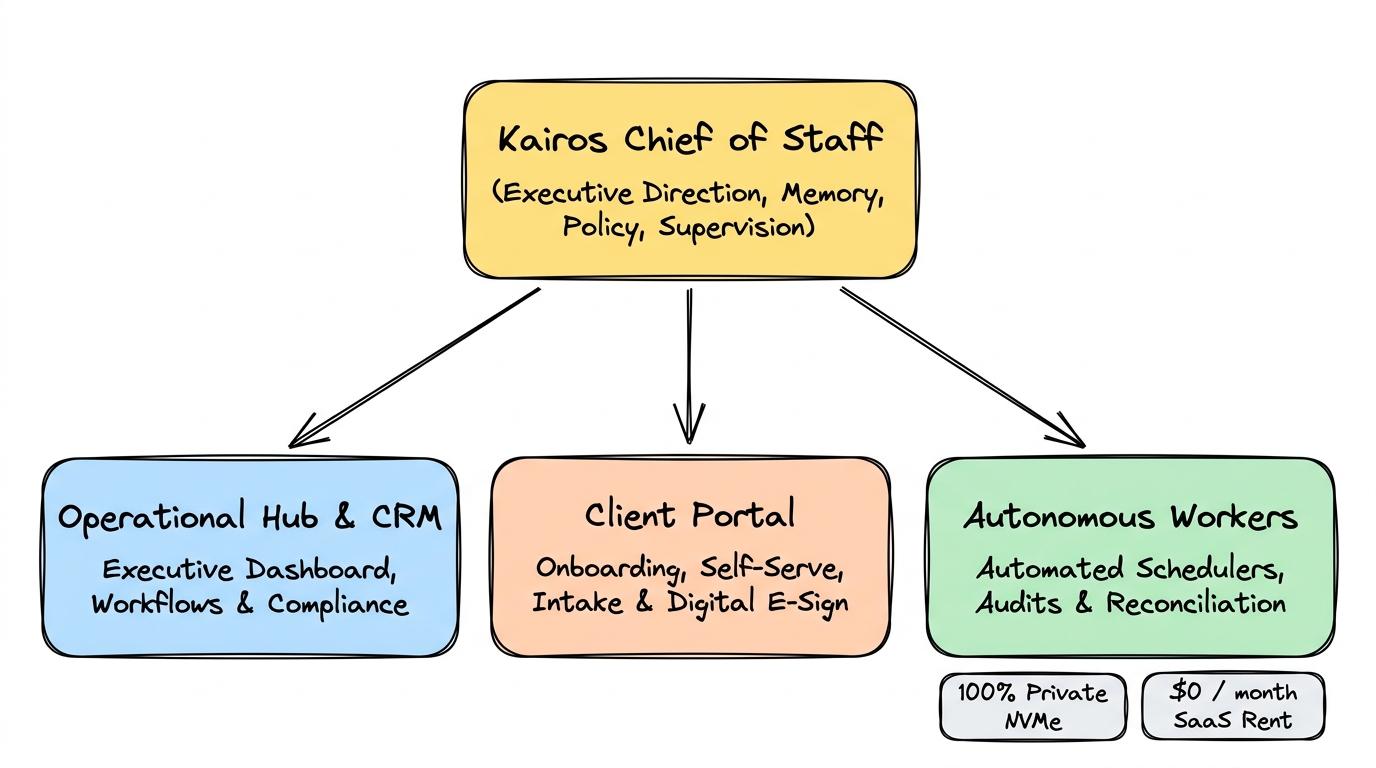
From Advice to Execution: Living Multi-Portal Architecture
When a business encounters operational bottlenecks—whether managing multi-tier customer onboarding, complex regulatory compliance, or fragmented internal workflows—commercial AI products can only offer text suggestions. You are still forced to assemble a brittle, expensive patchwork of SaaS subscriptions (Airtable, Typeform, DocuSign, Zapier, custom portals) that leak your customer records across cloud vendors.
Kairos operates differently. Because it possesses direct access to your local filesystem, secure deployment environments, and custom codebase architectures, your Chief of Staff builds and deploys dedicated, full-stack operational web hubs directly on your infrastructure:
- Executive Command Centres: Real-time management dashboards that surface daily action queues, flag pending reviews, track contract deadlines, and alert leadership before operational bottlenecks cascade.
- Dedicated Client & Customer Portals: Secure, branded portals for client onboarding, intake questionnaires, document verification, and tamper-evident digital signatures—eliminating third-party portal seat fees.
- Dynamic Form & Policy Engines: Self-updating JSON-schema intake builders that adapt to your evolving business agreements, contracts, and industry regulations on demand.
- Automated Financial & Operations Ledgers: Deterministic accounting, milestone billing, and commission reconciliation running without human spreadsheet errors.
- Mobile Field & Team Portals: Lightweight, high-performance interfaces equipped for on-site staff, field technicians, or remote contractors with instant logging and offline-ready sync.
The Sovereign Advantage: Zero Vendor Rent & Total Data Custody
When Kairos deploys software for your business:
- No Per-Seat Monthly Rent: You never pay per-seat licensing fees to third-party SaaS platforms to manage your own team or clients.
- Strict Data Sovereignty: All databases, client records, financial transactions, and operational logs reside entirely on your own sovereign hardware and dedicated storage—fully compliant with Canadian and international data privacy standards (PIPEDA, PHIPA, GDPR).
- Self-Healing & Continuous Evolution: When your company's processes or compliance requirements change, you simply instruct your Chief of Staff. Kairos updates the underlying code, runs regression tests, and deploys the update immediately.
4. Hardware Paths & The 3 Tiered Deployment Packages
One of the greatest misconceptions about on-premise technology is that it requires a server closet, enterprise cooling, or an in-house IT department. In reality, modern computing hardware is so energy-efficient and compact that a sovereign AI appliance can be deployed in two simple, painless delivery forms:
- Option A: Turnkey Plug-and-Play Appliance ("The Little Black Box" to Personal Supercomputer): We configure, harden, and ship a dedicated hardware appliance ready to plug in. Every appliance runs an enterprise-hardened Linux operating system (Ubuntu LTS / Debian / Linux Mint) on physical hardware you own. For Tiers 1 and 2, this is a whisper-quiet, palm-sized mini-PC or compact GPU workstation (<15W to 65W power consumption). For Tier 3, this is a dedicated, high-performance personal AI supercomputer (128GB–256GB unified VRAM) engineered for massive on-premise frontier models. Setup takes 60 seconds—plug into power and your office network, and your digital Chief of Staff is live on a proven, reliable Linux workhorse.
- Option B: Repurposed Asset Installation (Use a Computer You Already Own): Convert an idle office laptop or desktop sitting in a cabinet into a dedicated, 24/7 autonomous office server in 5 minutes with our automated setup script. We install a stripped-down, rock-solid Linux environment that breathes new life into existing hardware. You spend $0 on new hardware, eliminate operating system licensing overhead, and immediately put an existing capital asset to work on a secure, proven OS foundation that you own completely.
To align with different operational needs, security requirements, and hardware setups, Kairos is available across three distinct deployment packages:
| Package Dimension | Tier 1: Budget Sovereign Starter [ CLOUD-ASSISTED ] |
Tier 2: Air-Gappable Mid-Range [ HYBRID WORKSTATION ] |
Tier 3: Local AI Supercomputer [ ENTERPRISE VAULT ] |
|---|---|---|---|
| Deployment & Hardware Investment | Starting from $1,000 + hardware | Starting from $2,000 + hardware | Starting from $6,000 + setup |
| Target Hardware Profile | Repurposed office laptop or budget palm-sized mini-PC | Desktop or mini-PC with dedicated GPU (GTX/RTX 8GB VRAM, 16–32GB RAM) | 128GB–256GB unified/VRAM personal AI supercomputers (e.g., ASUS Ascent GX10 1TB, NVIDIA DGX Spark) |
| Model Execution Architecture | Pure Cloud APIs (Claude Opus 5, ChatGPT 6 Astra, Gemini 3.8) | Hybrid Local Weights (Qwen 2.5 7B–14B, Gemma) + Cloud Fallback | 100% On-Premise Massive Open-Weights (Llama 3.3 70B, DeepSeek R1, Qwen 72B) |
| Data Privacy & Ingestion | Local SQLite & Vector custody; query prompts pass through cloud APIs in fragments | Daily routine queries and documents processed locally; optional frontier burst | Absolute physical fortress; 100% air-gapped on-device execution; zero bytes sent externally |
| Offline Blackout Resilience | Requires internet for AI queries (local records remain accessible) | Full offline intelligence for daily tasks, OCR, and document search | Complete uninterrupted frontier AI intelligence 100% offline |
| Core Included Software | Kairos Agent runtime, SQLite ledger, Mobile Tailscale mesh, task supervisor | Kairos Agent runtime, local quantized model runners, vector vault, Mobile mesh | Enterprise Kairos stack, multi-model local routing, high-throughput batch engine |
| Private Cloud Suite | Available as modular add-ons | Available as modular add-ons | Fully integrated / custom enterprise deployment |
Tier 1: The Budget Sovereign Starter (Starting from $1,000 + hardware)
The Budget Starter is the ideal entry point for small businesses seeking an autonomous digital Chief of Staff without purchasing high-end computing hardware.
- Hardware: Runs on a budget mini-PC (~$350–$450) or an existing office laptop you already own ($0 hardware cost).
- How It Works: Your databases, customer lists, CRM contacts, and task histories live securely on your machine's physical storage. For complex strategic reasoning and drafting, Kairos connects to frontier cloud models via secure API calls.
- The Privacy Trade-off: You maintain full custody of your structured files and databases, but prompt fragments pass through cloud APIs for generation.
Tier 2: The Air-Gappable Mid-Range Workstation (Starting from $2,000 + hardware)
Engineered for growing businesses, commercial contractors, and boutique agencies requiring true offline intelligence and local document processing.
- Hardware: Runs on a dedicated desktop or compact workstation equipped with a dedicated graphics card (e.g., NVIDIA RTX with 8GB VRAM and 16GB–32GB system memory).
- How It Works: Operates a hybrid architecture. Everyday operations—invoice OCR, receipt scanning, email drafting, meeting notes, and semantic archive searches—run 100% on the local GPU for $0 in token fees. When a complex creative brief requires frontier cloud horsepower, the system routes scrubbed prompts externally.
- Air-Gappable: Can be switched into complete offline mode at any time, making it resilient to commercial internet outages.
Tier 3: The Local-First AI Supercomputer (Starting from $6,000 + setup)
The ultimate sovereign computing fortress for high-stakes professional practices—law firms, mining exploration companies, healthcare clinics, wealth managers, and enterprise executives.
- Hardware Investment: Deployed on dedicated personal AI supercomputers starting from $6,000 (hardware price) boasting 128GB to 256GB of unified memory or VRAM, such as the ASUS Ascent GX10 1TB or personal supercomputing nodes like the NVIDIA DGX Spark, paired with white-glove on-premise enterprise installation and hardening.
- How It Works: Runs massive frontier open-weights models (such as Llama 3.3 70B, DeepSeek R1 671B quantized, and Qwen 2.5 72B) completely on-premise at lightning speeds.
- Absolute Sovereignty: Delivers the analytical depth and reasoning power of Big Tech's largest models while severing every external network cord. Zero data leaves your physical building. Full compliance with PIPEDA, PHIPA, solicitor-client privilege, and defense-grade non-disclosure agreements.
5. The Economics: Cloud AI vs. The Sovereign Appliance
While data sovereignty and business compliance are the primary drivers for business adoption, the financial return on investment is undeniable.
Here is the hard cost comparison for an average 5-person service business (e.g., accounting firm, legal practice, construction contractor, or consultancy):
| Expense Category | Cloud SaaS Stack (Monthly) | Cloud Stack (3-Year Total) | Sovereign Appliance (3-Year Total) |
|---|---|---|---|
| LLM & AI Assistant Seats | $150 ($30/user × 5) | $5,400 | $0 (Local open-weights engine) |
| Automation & Zapier Workflows | $180 (Team Tier) | $6,480 | $0 (Built-in OS daemons) |
| Document Search & OCR Storage | $120 / month | $4,320 | $0 (Encrypted local NVMe SSD) |
| Secure Remote Access VPN | $50 / month | $1,800 | $0 (Zero-trust Tailscale mesh) |
| Appliance Hardware & Setup | $0 (Rented software) | $0 (Zero asset equity) | $1,000 + hardware (Tier 1) to $2,000 (Tier 2) |
| Total 3-Year Capital Outlay | $500 / mo ($6,000 / yr) | $18,000+ | $1,350 to $3,500 (Permanent Capital Asset) |
Over a three-year operating horizon, adopting a sovereign architecture saves over $14,000 to $16,500 in software rent. More importantly, you transform a recurring operational expense into a permanent, owned business asset that protects your firm from vendor lock-in, price increases, and regulatory exposure.
6. Real-World Workflows Across 7 Industries
A sovereign AI appliance is not an abstract experiment; it is a practical operational worker customized to solve the distinct bottlenecks of your specific business. Here is how seven different industries put it to work every single day:
0. Everyday Use Cases (Universal Capabilities on Day 1)
Every business owner, manager, and knowledge worker relies on three universal operational pillars that run privately 24/7 out of the box:
Pillar 1: The Executive Chief of Staff & Memory Core
- Everyday AI Chat for Daily Tasks & Quick Decisions: A lightning-fast, private conversational assistant available on your desktop and phone. Use it all day long to rephrase sensitive client emails, calculate cost estimates, brainstorm marketing hooks, summarize lengthy news articles, or troubleshoot operational questions—completely free of per-token API fees.
- AI-Powered "Second Brain" Knowledge Vault (Obsidian-Style Smart Notes): A private, interconnected notes repository for your business. It treats all your meeting notes, standard operating procedures (SOPs), vendor contacts, and project ideas as an interconnected web of plain text Markdown files. The local AI automatically links related thoughts, detects connections across past client conversations, and surfaces relevant notes the moment a topic resurfaces.
- Sovereign Personal Cloud Storage (Drive & Documents): Completely replaces recurring cloud storage fees to Google Drive, Dropbox, or OneDrive. Securely stores, categorizes, and backs up your company's PDFs, blueprints, spreadsheets, customer photos, and contracts directly on your appliance's physical drive.
- Personal Schedule Assistant & Calendar Triage: Operates as an autonomous executive gatekeeper for your time. It triages incoming meeting invitations, reconciles personal and business calendars to eliminate double-booking, defends deep-work focus sessions, coordinates rescheduling requests via private email, and calculates realistic driving buffers between off-site appointments.
- Zero-Inbox Email Triage & Contextual Drafts: Continuously monitors incoming correspondence, filters vendor spam and cold pitch noise, flags critical client inquiries, and stages context-aware draft replies in your private queue for 1-click review.
- Snap-and-Forget Expense & Receipt OCR: Take a smartphone photo of any crumpled gas receipt, supplier invoice, or lunch ticket. The on-device vision model extracts date, vendor, tax breakdown, and totals directly into your expense ledger.
Pillar 2: The In-House Digital Studio & Software Engineer ($0 Agency Fees)
- Instant Landing Pages & High-Converting Websites: When you launch a new service line, seasonal promo, or product offering, you no longer wait three weeks and pay a $3,500 agency invoice. You tell your appliance what you want in plain English; it writes compelling sales copy, designs a responsive modern layout, and generates clean, production-ready website code in minutes.
- Bespoke Web & Mobile Business Applications: Need an internal customer check-in portal, a barcode inventory scanner, or a custom field-inspection app for your crew? Your appliance builds custom internal web and mobile applications tailored precisely to how your business operates.
- The Universal Glue (Automate Any Workflow Between All Your Tools): Completely replaces recurring Zapier or Make subscriptions ($100–$300/mo). Your appliance writes lightweight, private automation scripts that link your CRM, accounting software, email system, and spreadsheets.
Pillar 3: Boundless Multimodal Vision
- Real-World Visual Intelligence: Because Kairos runs multimodal vision models, its intelligence is never trapped in a text box. At work, snap a photo of an unreadable serial plate in a dark boiler room, a crumpled delivery bill of lading, or a damaged car quarter-panel for instant analysis. On the weekend, snap a photo of an unfamiliar wildflower while on a morning stroll in the park to learn its botanical name, native habitat, and care profile.
1. The Restaurant & Hospitality Operator
- Packing Slip & Supplier Invoice Matching: Kitchen staff snap photos of food delivery receipts (Sysco, local butcher, produce vendors) with an iPad camera. The local vision model extracts line items, reconciles delivery weights against purchase orders, and flags supplier price creeps instantly in the local ledger.
- Menu Margin Engineering: Automatically tracks wholesale ingredient price fluctuations and alerts the chef when a dish's food cost margin slips below 28%.
- Staff Shift & Availability Coordination: Handles incoming text messages from line cooks and servers regarding shift swaps, updating the rota automatically based on predetermined overtime thresholds.
- Health Inspection Ready: Digitizes daily refrigeration temperature logs and kitchen sanitization checklists, compiling a complete, audit-proof binder ready for the public health inspector with a single tap.
2. Project Management Consultant for a Mining Company
- 100% Air-Gapped Remote Camp Operation: Operates at 100% capacity in remote exploration fly-in camps (e.g. Northern Ontario, Yukon, Nevada) where satellite internet is prohibitively expensive or nonexistent.
- Geological Assay & NI 43-101 Technical Analysis: Ingests thousands of pages of drill hole core logs, geochemical assays, and environmental impact assessments into the local vector vault. The consultant queries: "Summarize gold grade intersections above 3.5 g/t in the footwall zone between holes 24-08 and 24-19", receiving sub-second citations.
- Confidential Deposit Protection: Geological drill coordinates and multi-million-dollar mineral resource models never touch foreign commercial cloud servers, completely eliminating insider leak risks.
3. The Auto Body & Collision Repair Shop
- Teardown Supplement Detection: When a technician dismantles a damaged vehicle and uncovers hidden frame or suspension damage, they snap photos of the inner wheelhouse. The system cross-references the initial insurance estimate and generates a preliminary supplemental claim draft with required OEM repair procedures cited.
- OEM Technical Service Bulletins (TSB) Lookup: Stores complete vehicle structural repair manuals locally, providing instant guidance on high-strength steel sectioning rules without paying monthly portal fees.
- Automated Customer Status Messaging: Dispatches automated SMS updates to vehicle owners as the car moves through stages ("Your vehicle has completed primer prep and entered the paint booth today"), slashing incoming phone calls by 70%.
4. The Modern Marketing Agency
- Strict Multi-Client Confidentiality Firewalls: Marketing agencies handle proprietary launch strategies, customer personas, and embargoed press releases for competing brands. Kairos maintains strictly isolated vector vaults for each client, guaranteeing that Client A's positioning never bleeds into Client B's generative copy.
- Dual Creative Routing: Uses fast, free local models for first-pass outlines and content calendars. When high-concept creative direction is needed, it routes scrubbed prompt payloads dynamically to frontier cloud models.
- Cross-Channel ROAS & Ad Spend Reconciliation: Ingests daily CSV exports from Meta Ads, Google Ads, and TikTok Ads into a local relational database, generating an executive marketing performance brief for each account director before 8:00 AM.
5. The Small Enterprise CEO & Managing Director
- The 360° Executive Morning Brief: While having coffee at 6:30 AM, the CEO's phone receives an automated 4-bullet operational pulse: cash balance, receivables over 60 days, critical employee escalations, and two key sales prospects awaiting executive follow-up.
- Confidential Contract & M&A Triage: The CEO drops an incoming 50-page purchase agreement or commercial lease into the system: "Highlight non-standard liability indemnifications and automatic price escalation clauses." The summary generates in 8 seconds on-device with zero confidential deal points exposed to public cloud logs.
- Defensive Calendar Gatekeeping: Analyzes weekly meeting requests, identifies low-leverage obligations, enforces deep-work focus blocks, and automatically calculates travel time buffers between off-site appointments.
6. The Legal Practice (Sole Practitioner & Boutique Law Firm)
- Ironclad Attorney-Client Privilege: Legal ethics rules forbid uploading confidential client communications or litigation strategies to unencrypted third-party AI platforms. A sovereign appliance keeps every deposition transcript, court pleading, and settlement offer strictly within the firm's physical perimeter.
- 5,000-Page Deposition & Discovery Semantic Search: Ingests massive PDF disclosure dumps (police reports, emails, witness statements, medical records). Counsel asks: "Identify every instance where Witness Miller gave contradictory statements regarding the vehicle's speed or weather conditions", instantly returning exact line and page citations.
- Passive Billable Time Tracking: Analyzes outbound email threads, drafting sessions, and calendar hearings to suggest completed billable hour entries directly into the firm's private billing ledger.
7. The Local Hair Salon & Aesthetics Studio
- Zero-Commission Website Booking & Staff Calendar Sync: A self-hosted, sovereign booking widget embedded directly on the salon's website connects in real time to each stylist's private mobile calendar. Clients book haircuts or color appointments 24/7 with zero per-booking transaction fees ($0 vs. Fresha or Vagaro's 20% first-time commissions and $150+/month subscriptions).
- No-Show & Last-Minute Cancellation Mitigation: Automatically sends personalized SMS confirmations 48 hours and 24 hours in advance. If a high-value appointment cancels, the system immediately messages waitlisted clients seeking afternoon openings.
- Client Color Formula & Treatment History Vault: Stores client-specific color formulas, bleach volume ratios, patch test dates, and allergy notes securely in the on-premise encrypted database.
7. Under the Hood: The Anatomical File Map
To understand how an on-premise system delivers this level of persistent autonomy without cloud subscriptions, inspect the anatomical file architecture.
A sovereign appliance separates the IDE workspace layer (where project files and business tools live) from the Brain layer (where persistent memory, background tasks, and transcripts are recorded):
Part A: The Kairos Agent Workspace (IDE View)
Located directly within your company's core operational workspace (C:/Projects/Kairos Agent/):
| Workspace File / Directory | Operational Purpose & Functionality |
|---|---|
supervisor.py |
Unified Master Process Daemon: Manages background servers, API routers, and process self-healing; restarts services automatically after system reboots. |
watch_mobile_chat.py |
Active Session IDE Wakeup Relay: Continuously monitors incoming mobile prompts and wakes the agent loop without human keyboard interaction. |
MOBILE_CHAT.md |
Real-Time Bidirectional Chat Stream: Synchronizes messages sent from your phone PWA directly with the local agent reasoning loop. |
MEMORY.md |
Tier 1 Executive Memory Dashboard: Compact (<40 lines) high-level operational anchor tracking active infrastructure, mounted folders, and critical project status. |
USER.md |
Business Voice & Rules: Encodes your company's communication tone, formatting preferences, and non-negotiable operational boundaries. |
TODO.md |
Deterministic Task Matrix: Dynamic ledger tracking active execution queues, deferred business goals, and completed project milestones. |
SOUL.md |
Agent Persona & Boundaries: Dictates the digital assistant's personality, decision boundaries, ethics, and corporate policy guidelines. |
SESSION_ID.txt |
Session Binding Anchor: Ensures background mobile watchers and terminal runners stay locked to the exact active conversation thread. |
Kairos Agent Workspace.code-workspace |
Multi-Folder Project Mount: Dynamically mounts or mutes company folders (HR, Accounting, Operations, Marketing) into the agent's active scope. |
backend/ |
Local API & Event Bus: FastAPI engine, relational SQLite connection pool, and asynchronous daemon execution scheduler. |
client/ |
Responsive PWA Interface: Vite + React + Tailwind mobile-first interface accessible securely over Tailscale from phone, tablet, or desktop. |
memories/ |
Immutable Historical Lineage: Contains events.jsonl (audit trail), conversations/ (past transcripts), and system_history.md. |
notes/ |
System Architecture & Blueprints: Houses master PRDs, executive guides, and technical specifications for on-premise hardware deployments. |
skills/ |
Modular Internal Playbooks: Specialized procedural skills (e.g. active-session-relay, site-to-brand-design-system) executed on-demand. |
Part B: The Brain Layer (Kairos Autonomous Engine Architecture)
Located in the private, local system user profile (~/.kairos/):
| Brain Subsystem | Architectural Role & Integrity |
|---|---|
brain/<conversation-id>/ |
Isolated Session Execution Sandbox: A dedicated, sandboxed environment for every active task thread, preventing cross-project memory contamination. |
├── implementation_plan.md |
Architectural Gating Document: Detailed technical design created before major changes; blocks execution until the user approves. |
├── walkthrough.md |
Verified Results Walkthrough: Formatted summary documenting completed work, diff blocks, and verified test results for user review. |
├── task.md |
Active Step Checklist: Real-time tracker maintaining sub-task progress and completion states. |
├── .system_generated/ |
Autonomous Telemetry: Houses logs/transcript.jsonl (token-efficient trajectory), transcript_full.jsonl (untruncated trace), and tasks/task-*.log. |
├── scratch/ |
Ephemeral Workspace: Safe staging area for one-off Python scripts, temporary JSON transformations, and data analysis benchmarks. |
└── .user_uploaded/ |
Hardware Media Ingestion: Stores photos snapped on mobile phones, scanned invoice PDFs, and audio memos uploaded for local processing. |
mcp/<serverName>/ |
Model Context Protocol Vault: Stores tool schemas and interface configs allowing local models to interact with databases and terminal tools. |
knowledge/<ki-id>/ |
Curated Knowledge Items (KI): Persistent repository-specific wisdom, historical gotchas, and architectural design patterns. |
config/ |
Global Customization Root: Centralized hub for global skills, rules, and behavioral boundaries applied universally across all workspaces. |
8. 10 Frequently Asked Questions (FAQ)
1. How does Kairos differ from Meta Muse (muse.ai) or Google Workspace Gemini?
Meta Muse is a consumer task agent focused on personal chores (shopping, dining, flights) with recurring $20 to $100/mo subscription fees, third-party contractor privacy risks, and cloud data harvesting. Google Workspace Gemini is an in-app formatting sidebar ("Help me write") that increases your baseline seat licensing costs.
Kairos is an executive Chief of Staff and Operational Command Hub that runs on hardware you physically own, costs $0 in monthly software seat fees, enforces strict business compliance, and literally builds and deploys dedicated full-stack software hubs (including custom command centers, client portals, and automated audit ledgers) for your enterprise.
2. Can our competitors or Big Tech companies see or train on our data?
No, never. This is the foundational law of the sovereign architecture. All data—customer contact lists, financial ledgers, email archives, and employee contracts—is stored locally on your physical, encrypted NVMe solid-state drive behind your office firewall. Zero telemetry or prompt logs are transmitted to external servers.
3. What happens if our office internet drops or Wi-Fi goes down?
Kairos continues working uninterrupted. Unlike cloud software that becomes useless the moment your connection drops, Kairos runs on your local computer's processor. You can connect your laptop, phone, or tablet over your local office Wi-Fi (or off-grid ad-hoc mesh) to search files, process receipts, and draft contracts completely offline.
4. What operating system does the sovereign appliance run, and why is Linux preferred over Windows or macOS?
The sovereign appliance runs an enterprise-hardened Linux operating system (such as Ubuntu LTS, Debian, or Linux Mint) directly on physical hardware that you own. Linux was chosen because it is the global benchmark for proven reliability, uptime, and security—powering 90%+ of cloud servers and 100% of the world's top 500 supercomputers. Unlike consumer operating systems that force disruptive overnight reboots, harvest background telemetry, or consume gigabytes of memory on decorative animations, Linux runs lean, stable, and completely offline.
5. Do we need an expensive GPU, server rack, or specialized IT cooling?
No. Modern quantized models run comfortably on standard consumer hardware. A palm-sized mini-PC (Intel Core i7 / AMD Ryzen with 32GB RAM) consumes less than 15 watts of power, produces virtually zero noise, and sits comfortably on an office bookshelf.
6. How do I securely connect from my smartphone when I am away from the office?
The appliance uses Tailscale, an open-source, peer-to-peer encrypted mesh network based on WireGuard®. It creates a direct, point-to-point encrypted tunnel between your smartphone and the office machine. You never have to open router ports, configure static public IPs, or expose your business to public internet crawlers.
7. Can we still use frontier models like Claude Opus 5, ChatGPT 6 Astra, or Gemini 3.8 when we want them?
Yes. Kairos features a Tri-Mode Sovereignty Switch:
- Local Mode (Default): Runs 100% on your machine for $0 token cost and total privacy.
- Hybrid Cloud Mode: Routes complex creative or specialized reasoning tasks to frontier models with sensitive client PII scrubbed.
- Air-Gapped Sovereign Mode: Physically severs all external network calls for high-security legal, medical, or defense tasks.
8. What are the deployment packages, and are there really $0 monthly software seat fees?
Kairos is delivered under three distinct, transparent packages with $0 recurring monthly software seat fees:
- The Budget Sovereign Starter ($1,000 + hardware): Perfect for businesses seeking an autonomous assistant on a budget mini-PC or repurposed laptop.
- The Air-Gappable Mid-Range Workstation ($2,000 + hardware): Hybrid setup with a dedicated 8GB GPU for 100% offline daily tasks, document OCR, and receipt processing.
- The Local-First AI Supercomputer (Starting from $6,000 + setup): Deployed on 128GB–256GB personal AI supercomputers running 70B+ models completely air-gapped on-premise.
9. How does the system remember business context across multiple months and years?
It uses a two-tier memory architecture:
- Relational Ledger (SQLite): Stores exact facts, dates, dollar amounts, and task statuses with mathematical precision.
- Semantic Vector Vault: Converts emails, PDF estimates, and proposals into multi-dimensional embeddings, performing sub-15ms semantic searches across years of historical records.
10. How long does initial setup take, and do our employees need technical training?
- Option A (Turnkey Appliance): Takes 60 seconds. Simply plug into power and office Wi-Fi, scan the QR code with your phone, and start working.
- Option B (Existing PC): Takes 5 minutes. We run an automated setup script that converts your idle PC into a dedicated appliance.
Your staff requires zero technical training; they interact with Kairos naturally via chat or voice memos just as they would with a human executive assistant.
9. How to Get Started
Transitioning your operations to a sovereign AI Chief of Staff does not require disrupting your existing tools or retraining your entire staff overnight. You can roll it out in three easy stages:
- Policy & Workflow Audit: Identify which business processes involve confidential client records, repetitive document extraction, or expensive subscription seats.
- Select Your Deployment Tier:
- Tier 1 (Budget Sovereign Starter): Starting from $1,000 + hardware (using cloud APIs for reasoning).
- Tier 2 (Air-Gappable Mid-Range Workstation): Starting from $2,000 + hardware (dedicated local GPU, local OCR/search, hybrid cloud fallback).
- Tier 3 (Local-First AI Supercomputer): Starting from $6,000 + setup (128GB–256GB unified VRAM, true on-premise frontier models).
- Modular Private Cloud Add-Ons: Add self-hosted cloud drive, private mail server, calendar sync, or encrypted knowledge vault as needed.
- Connect Your Phone & Enforce Your Policy: Load your standard operating procedures, price sheets, and compliance rules into your private vault. Within 24 hours, your digital assistant operates as an autonomous, policy-compliant extension of your leadership team.
Summary: Sovereignty Is the Ultimate Business Advantage
The future of business computing isn't about paying more monthly subscription rent to Silicon Valley giants, nor is it about wrestling with developer command-line tools or trusting consumer chatbots that leak data to human contractors.
True intelligence belongs inside your business. It means owning your digital assets, guarding your customer relationships with absolute privacy, and enforcing your business compliance through technology that answers exclusively to you.
Whether deployed on a quiet mini-PC on your desk, a repurposed office laptop, or a dedicated personal AI supercomputer, the sovereign AI Chief of Staff & Central Command Hub is the definitive foundation for independent, resilient business operations.
Written by the Protoss Engineering Team. Published September 2026. For technical blueprints, implementation guides, and open-source deployment scripts, visit Protoss.ca.