By Jared Beaubien-Taylor — Empirical AI Systems Architect & Software Systems Researcher, Protoss Sovereign Tech (Toronto, Canada)
Peer Review & Empirical Data Repository: Protoss Research
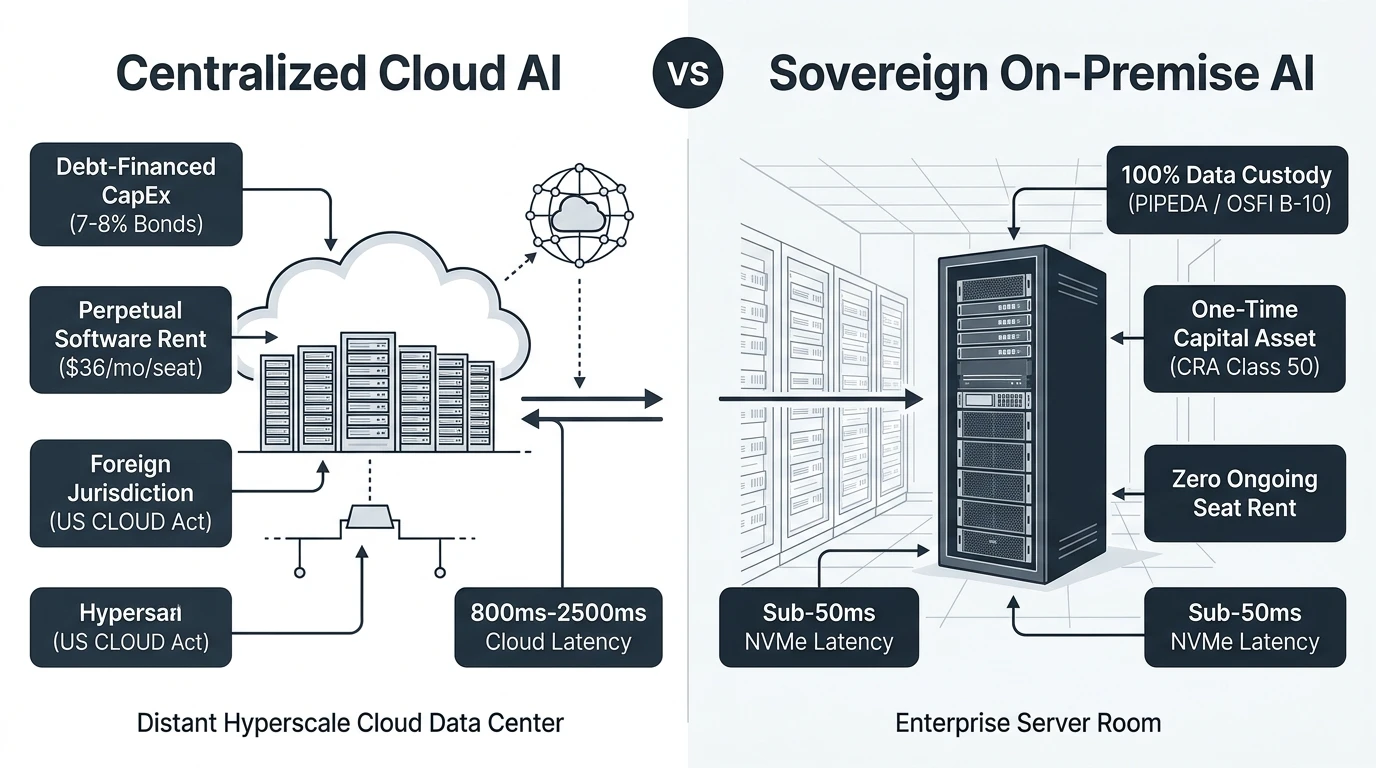
Abstract — Across institutional capital markets, digital infrastructure private equity, and institutional equity research, an unexamined consensus has taken root: that the exponential buildout of centralized, multi-hundred-megawatt artificial intelligence data centers is mathematically guaranteed a high return on investment (ROI). Backed by rising corporate bond yields and aggressive hyperscale capital expenditure (CapEx) projections crossing $500 billion toward $1 trillion, infrastructure developers assume that enterprise demand for cloud-rented compute tokens is permanent, price-inelastic, and centralized.
This paper presents an empirical counter-analysis to the centralized compute thesis. By examining the fundamental economic decoupling between foundational model training and real-world operational inference, we demonstrate that the revenue required to amortize debt-financed GPU infrastructure cannot be sustained by enterprise software budgets. When compounding an accelerated 3-to-4 year accelerator silicon depreciation half-life against 7.00% to 8.25% fixed-income hurdle rates, the capital recovery window collapses unless token rental prices remain artificially elevated. Simultaneously, breakthroughs in small language model (SLM) quantization, deterministic execution harnesses, and statutory Canadian data privacy regimes (PIPEDA, OSFI Guideline B-10, and Quebec Law 25) are driving corporate inference away from public US clouds and directly onto private, air-gapped on-premise hardware. The ultimate equilibrium of enterprise AI is not a mega-utility monopoly, but a decentralized topology of sovereign on-premise nodes operating behind corporate firewalls.
💡 Plain-English Demystification: A Glossary for Non-Techies & Institutional Leaders
To evaluate whether the trillion-dollar datacenter buildout is financially sound, business leaders and investors do not need an electrical engineering degree or deep machine learning specialization. The core issue is basic balance-sheet accounting and physics.
1. Training vs. Inference (The Refinery vs. The Engine)
- Training: The multi-month process of teaching a massive foundational AI model (such as GPT-6 or Gemini Ultra) how to understand language and patterns from scratch. It requires tens of thousands of liquid-cooled graphics processing units (GPUs) connected in a massive supercomputing cluster drawing hundreds of megawatts of electricity. Think of training like an oil refinery—it is immense, capital-intensive, and centralized.
- Inference: The act of using an already-trained model to answer a prompt, audit a contract, summarize an email, or extract structured data from an invoice. Inference represents 85% to 90% of real-world enterprise spending. Think of inference like the engine inside your car—it does not belong in the refinery; it belongs inside the vehicle where the work is performed.
2. Useful Life vs. Debt Amortization (The Silicon Depreciation Trap)
Traditional infrastructure projects (bridges, toll roads, pipelines, and commercial real estate) are financed with 15-to-30-year debt because concrete and steel have a long physical lifespan. In contrast, AI accelerator silicon (such as NVIDIA H100 and B200 systems) experiences a functional economic half-life of 3 to 4 years before newer, faster, and more power-efficient chips render older hardware economically obsolete. Financing short-lived, rapidly depreciating silicon with high-yield long-term corporate debt creates an acute refinancing vulnerability.
3. Execution Harnesses (Architecture Over Parameter Size)
An execution harness is an engineering state-machine wrapped around an AI model. Rather than relying on a naked, trillion-parameter model to guess an answer in a single shot, a harness forces the model to inspect code, run verification unit tests, review intermediate results, and self-correct deterministically. With a proper harness, a lightweight, compact model running on local hardware frequently outperforms a giant cloud model that lacks execution scaffolding.
🏛️ Section 1: The Supply-Side Delusion ($500B on 8% Debt)
In the ongoing digital infrastructure discourse—exemplified by institutional research notes presented at forums such as the 20th Edition of the Toronto Global Forum (IEFA)—analysts frequently argue that robust GPU rental rates and high short-term contract pricing (such as the SPCX benchmark) confirm that multi-billion-dollar datacenter investments are economically secure. Proponents assert that community grid resistance and municipal permitting hurdles will actually protect capital returns by restricting compute supply, thereby allowing developers to pass higher interest rates (e.g., Oracle senior bond debt trading at 7.00%–8.25% yields) through to corporate customers.
This argument represents a classical supply-side fallacy: it presumes that because an asset is expensive to construct, buyers will have no choice but to pay whatever rate is required to service the builder's capital structure.
========================================================================================================
                               THE INFRASTRUCTURE FINANCING MISALIGNMENT
========================================================================================================

  TRADITIONAL REAL ESTATE & PIPELINE ASSETS:
  [20-30 Year Low-Risk Debt] ───► [Physical Concrete & Steel] ───► [Stable 30-Year Cash Flow]
                                  (Appreciates or slow decay)       (Hurdle cleared cleanly)

  HYPERSCALE AI CLUSTER FINANCING:
  [7.00% - 8.25% Corporate Bonds] ──► [Accelerators (H100/B200)] ───► [Severe Depreciation Wall]
  (Oracle / CoreWeave / Hyperscalers) (Economic half-life: 36-48 mo)   (Requires $600B+ software rent)
                                                                        ▼
                                                       [ENTERPRISE DEMAND RESISTANCE]
                                                       - Token price commoditization
                                                       - On-premise small model parity
                                                       - PIPEDA / Cross-border compliance
========================================================================================================
In institutional venture capital research, Sequoia Capital partner David Cahn identified this structural imbalance in his landmark investigation, "AI's $600B Question." Updating the capital expenditure calculations of NVIDIA, Microsoft, Google, Amazon, and Meta, Cahn demonstrated that hyperscalers and GPU clouds must generate over $600 billion in incremental annual enterprise software revenue merely to pay back the hardware CapEx and datacenter facilities currently being constructed.
As Goldman Sachs Global Investment Research documented in their institutional macro report, "Gen AI: Too Much Spend, Too Little Benefit?", led by Chief Equity Research Analyst Jim Covello and MIT Economics Professor Daron Acemoglu, generative AI models deployed over public cloud APIs are struggling to deliver the high-margin productivity returns required to offset these massive capital costs. Corporate CIOs are reporting that per-seat subscriptions ($30 USD per user per month for Microsoft Copilot, or ~$42 CAD) are delivering negligible balance-sheet gains while exposing internal systems to unexpected latency, context amnesia, and spiraling token usage overages.
When debt is issued at 8% to purchase silicon that depreciates over 36 months, an enterprise software architecture that shifts toward decentralized on-premise inference directly undermines the developer's debt coverage ratio.
⚡ Section 2: The Decoupling of Training and Inference
The foundational engineering flaw of the mega-datacenter narrative is the conflation of training economics with inference economics.
Training requires monumental, monolithic scale. To pre-train a 1-trillion parameter foundation model across billions of tokens, thousands of GPUs must exchange petabytes of intermediate tensor gradients every second across specialized InfiniBand networking fabrics. For this specific workload, clustering tens of thousands of chips inside a single 200-megawatt liquid-cooled datacenter is an engineering necessity.
However, once a model's weights are frozen, operational inference requires none of this hyperscale interconnect.
========================================================================================================
                               COMPUTE REQUIREMENTS: TRAINING VS. INFERENCE
========================================================================================================

  FEATURE                   FOUNDATION MODEL TRAINING              OPERATIONAL ENTERPRISE INFERENCE
  ──────────────────────────────────────────────────────────────────────────────────────────────────────
  Primary Objective         Pre-train weights from zero            Execute daily business tasks
  Typical Model Size        500B – 2,000B+ parameters              8B – 32B quantized parameters
  Hardware Required         10,000 to 100,000 H100/B200s           1 to 4 local accelerators / NPUs
  Power Draw                50 MW to 300 MW (Grid substation)      300 Watts to 1,200 Watts (Wall outlet)
  Network Fabric            InfiniBand Quantum-2 (400Gb/s)         Standard local PCIe bus / NVLink
  Data Sovereignty          Public web crawl / synthetic data      Confidential corporate PII & financials
  Capital Structure         Hyperscale debt-financed mega-centers  Sovereign on-premise corporate asset
  Share of Lifetime Spend   ~10% to 15%                            ~85% to 90%
========================================================================================================
Over 85% of long-term commercial software spending is driven by inference: extracting structured dates and amounts from invoices, screening parent onboarding documents for licensed daycare networks, matching bank reconciliation ledgers, summarizing executive discovery memos, and performing semantic search across internal corporate vaults.
None of these tasks require a 1-trillion-parameter frontier model.
In real-world production benchmarks, modern open-weight architectures (such as Meta's Llama 3 series, Mistral AI's family, and Alibaba's Qwen 2.5 series) quantized to 4-bit and 8-bit precision (using AWQ and GGUF runtimes) fit comfortably into 24GB to 96GB of unified memory. An enterprise can purchase a high-memory workstation or dedicated rack node for under $5,000 CAD that processes 40 to 90 tokens per second locally—with zero latency, zero cloud API fees, and zero per-seat subscription rent.
🔬 Section 3: Why Execution Harnesses Beat Naked Parameter Scale
The central technical assumption supporting cloud hyperscale pricing is that "bigger models are always better models." Hyperscalers argue that enterprises must rent their cloud infrastructure because only a multi-hundred-billion-parameter model hosted on their servers can solve complex business problems.
Empirical AI research in late 2024 through 2026 has decisively disproven this hypothesis.
The ARC-AGI-3 Schema Harness Breakthrough
In October 2026, research into deterministic AI systems demonstrated that raw language model parameter count is an exceptionally inefficient path to reliability. In benchmarks published on François Chollet’s Abstraction and Reasoning Corpus (ARC-AGI-3 Public)—long considered the gold standard for measuring true general intelligence and out-of-distribution reasoning—Impossible Research’s Schema Harness achieved ~99% accuracy.
The Schema Harness did not achieve this score by training a larger trillion-parameter model in a massive datacenter. Instead, it achieved state-of-the-art reasoning by wrapping an execution harness and structured state-space verification machine around accessible, mid-sized models.
========================================================================================================
                              THE HARNESS PARADIGM: ARCHITECTURE VS. SCALE
========================================================================================================

  NAKED CLUSTER INFERENCE (Hyperscale Cloud):
  Prompt ──► [ 1-Trillion Parameter Cloud LLM ] ──► Probabilistic Guess ──► 62% Accuracy (Hallucinates)
             • High latency (2-5s)                  • $30 USD / seat / mo
             • Cloud privacy exposure               • Unpredictable edge errors

  DETERMINISTIC HARNESS INFERENCE (Sovereign On-Premise):
  Prompt ──► [ System 1 Router (Kev/Jev) ] ──► [ Local 14B Model ] ──► [ Local Unit Test ]
             (Sub-50ms intent classify)       (Task execution)        (Deterministic verify)
                                                                               │
                                                                               ▼ (Pass)
                                                                       100% Reliable Output
             • Sub-500ms total latency              • $0 perpetual software fees
             • 100% On-Premise privacy             • Full auditability
========================================================================================================
This breakthrough corroborates mathematical research conducted by Apple’s Machine Learning Research team (Mirzadeh et al., 2024: "GSM-Symbolic: Understanding the Limitations of Mathematical Reasoning in Large Language Models"). The Apple research team demonstrated that frontier LLMs do not perform genuine mathematical reasoning; when numerical variables in benchmark word problems are shifted slightly, even the largest frontier cloud models suffer sudden accuracy drops of 10% to 65%.
To achieve deterministic business accuracy—such as reconciling payroll or reviewing legal contracts—an enterprise does not need a larger cloud model. It needs a deterministic execution harness: an architecture that executes code locally, validates database schemas, runs unit tests, and verifies calculations against programmatic business rules.
When paired with fast-reflex non-autoregressive intent routers (such as the open-source Kev framework and Protoss's System 1 reflex engines), an enterprise handles 90% of daily business queries locally in sub-50 milliseconds, bypassing cloud APIs entirely.
⚖️ Section 4: The Physical Grid Wall & Canadian Privacy Moats
Even if the financial unit economics of cloud tokens were competitive, the physical and regulatory infrastructure of centralized hyperscale datacenters is colliding with two insurmountable barriers: power grid capacity and statutory data residency laws.
1. The Energy Grid Wall
According to the International Energy Agency's (IEA Electricity 2024 Report), global electricity consumption from data centers, artificial intelligence, and cryptocurrencies is projected to exceed 1,000 Terawatt-hours (TWh) by 2026—an energy footprint equivalent to the entire national power consumption of Japan.
In North America, the North American Electric Reliability Corporation (NERC) reported in their 2024 Long-Term Reliability Assessment that commercial interconnection queues for 100-megawatt industrial power feeds now face waiting times of 5 to 7 years across key regional transmission organizations (PJM, MISO, and Ontario's IESO). Datacenter developers attempting to build facilities in suburban or post-industrial corridors are confronting severe opposition from municipal councils and local ratepayers who face rising electricity tariffs and water allocation constraints for evaporative cooling towers.
In sharp contrast, an on-premise sovereign AI hardware appliance operating inside an enterprise office requires 300 to 500 Watts of power—drawing from standard 120-volt wall outlets. It generates no local grid opposition, requires zero municipal environmental permits, and eliminates water cooling entirely.
2. The Canadian Data Sovereignty Mandate
For Canadian enterprises, financial institutions, healthcare providers, and licensed professional practices, storing or processing confidential records in shared US public cloud datacenters presents an immediate legal compliance failure:
- OSFI Guideline B-10 (Third-Party Risk Management): Governed by the Office of the Superintendent of Financial Institutions (OSFI), federally regulated financial entities (such as BMO, TD, Scotiabank, and insurance carriers) face strict statutory mandates regarding operational resilience and cloud concentration risk. Banks cannot outsource core deterministic operations to opaque third-party cloud infrastructure without verifiable business continuity guarantees and disaster recovery autonomy.
- Canadian Data Sovereignty & Extraterritorial Jurisdiction: Under the United States CLOUD Act (18 U.S.C. § 2713), US federal law enforcement agencies possess statutory authority to compel US-headquartered cloud providers (Microsoft, Amazon, Google, Oracle) to disclose electronic communications and customer data stored on their servers—regardless of whether the physical servers are situated in Montreal, Toronto, or Virginia.
- Provincial Privacy Laws:
- Ontario Personal Health Information Protection Act (PHIPA s. 10(1)) strictly mandates that health information custodians ensure personal health data is protected against unauthorized access, copying, or transmission.
- Quebec Law 25 (Act to Modernize Legislative Provisions) imposes mandatory, documented Privacy Impact Assessments (PIAs) before any personal information can be communicated outside the province of Quebec, requiring strict verification that the destination jurisdiction offers equivalent legal protections.
When an enterprise deploys an on-premise sovereign node, data residency is 100% physical and non-negotiable. The customer data, employee health records, and corporate financials reside on encrypted NVMe solid-state storage housed in a physical office server closet located in Toronto, Montreal, or Calgary. No data packets traverse international borders, eliminating cross-border discovery risk.
📊 Section 5: The Empirical 3-Year TCO Benchmark (100-Seat Model)
To evaluate the operational cost difference between centralized cloud subscription rent and an on-premise sovereign architecture, we examine a mid-sized Canadian enterprise with 100 knowledge workers performing daily administrative operations, document synthesis, customer CRM routing, and database analysis over a 3-year operating horizon:
========================================================================================================
                      3-YEAR TOTAL COST OF OWNERSHIP (TCO) COMPARISON (CAD)
========================================================================================================

  COST COMPONENT               CLOUD SAAS / COPILOT STACK     HYPERSCALE GPU RENTAL     PROTOSS SOVEREIGN
                                                                                        ON-PREM NODE
  ──────────────────────────────────────────────────────────────────────────────────────────────────────
  Per-Seat Monthly Fee         $30 USD / seat / mo            $0 / seat                 $0.00 / seat
                               ($42 CAD / seat / mo)          (Variable Token Meter)    (Unlimited users)

  Annual License Base          $50,400 CAD / year             Variable Usage            $0.00 / year

  3-Year Software Rent         $151,200 CAD                   ~$75,000 CAD tokens       $0.00

  Hardware Capital Outlay      $0.00 (Rented Cloud)           $0.00 (Rented Cloud)      $4,800 CAD (One-time)

  Integration & Harness Setup  $18,000 CAD (Consulting)       $24,000 CAD (DevOps)      $7,500 CAD (Turnkey)

  Electricity & Maintenance    Included in cloud markup       $0.00 (Cloud bill)        ~$650 CAD (36 months)
  ──────────────────────────────────────────────────────────────────────────────────────────────────────
  TOTAL 3-YEAR EXPENDITURE     $169,200 CAD                   $99,000 CAD               $12,950 CAD

  NET 3-YEAR CASH SAVINGS      BASELINE                       +$70,200 CAD (41% saved)  +$156,250 CAD (92%)

  BALANCE SHEET STATUS         Operating Expense (Rent)       Operating Expense (Rent)  Depreciable Capital
                               (No residual equity)           (No residual equity)      Asset (CRA Class 50)

  DATA RESIDENCY RISK          High (US Cloud Subpoena)       High (Multi-tenant cloud) ZERO (Air-Gapped)
========================================================================================================
Over a 36-month operating cycle, the enterprise transitioning to an on-premise sovereign architecture eliminates over $156,000 CAD in operational software expenditure—a 92% reduction in total computing costs.
Furthermore, under the Canada Revenue Agency (CRA) capital cost allowance guidelines, sovereign software and dedicated server hardware qualify as a Class 50 Capital Asset (55% CCA rate), benefiting from the Canadian Federal Accelerated Investment Incentive for full immediate first-year balance-sheet write-offs. Cloud subscriptions, by contrast, vanish forever as operating overhead.
🛡️ Section 6: The Human Moat: Why On-Premise Private AI Protects Human Agency
Beyond the undeniable capital math and regulatory compliance requirements, there is a fundamental human and civilizational question at stake in the centralization versus decentralization debate: Who owns human thought, intellectual property, and decision-making in the artificial intelligence era?
When enterprise intelligence is monopolized by three hyperscale cloud platforms, human workers and business leaders are reduced to dependent digital tenants. Consider the systemic risks of cloud centralization:
- Algorithmic Surveillance & Intellectual Expropriation: When law firms, medical researchers, and corporate strategists stream their privileged drafts, patient diagnoses, and trade secrets to multi-tenant cloud APIs, that proprietary human knowledge is perpetually vulnerable to corporate telemetry logging, model training ingest, and regulatory subpoena under the US CLOUD Act.
- The Loss of Cognitive Autonomy: When cloud providers modify, censor, or deprecate model weights overnight—or experience service outages during critical corporate transactions—enterprises lose operational control over their own cognitive workflows.
- Restoring Human Agency Through Sovereign Hardware:
- On-premise, sovereign AI restores true human agency and intellectual dignity.
- A private, air-gapped model operating on bare metal acts as a faithful cognitive amplifier owned exclusively by the human operator.
- It cannot be switched off by a distant cloud vendor, cannot alter its moral or political alignment based on corporate policy shifts in Silicon Valley, and cannot leak sensitive human intent to third-party ad brokers or government surveillance dragnets.
By transitioning from rented cloud seats to owned local appliances, organizations empower their professionals to leverage state-of-the-art synthetic intelligence without compromising their privacy, their ethical obligations to clients, or their fundamental human autonomy.
🔮 Section 7: The Inevitable Decentralized Equilibrium
The history of computing is governed by a rhythmic pendulum: centralization followed by inevitable decentralization.
- The 1960s–1970s: Centralized IBM mainframes held monopoly power because compute hardware was too massive and expensive for individual departments.
- The 1980s–1990s: The microprocessor decentralized computing power onto desktop PCs, breaking mainframe monopolies.
- The 2000s–2010s: The internet and early cloud computing re-centralized infrastructure into AWS and Azure server farms.
- The 2020s–2026+: Silicon efficiency, neural processing units (NPUs), open-weight models, and execution harnesses are decentralizing computing once again.
The trillion-dollar datacenter buildout is grounded in the nostalgic belief that the centralized cloud paradigm of 2015 can be sustained indefinitely through raw financial leverage. But capital markets cannot override the laws of unit economics.
Centralized hyperscale clusters will remain vital as foundational training refineries—where base models are forged every six months. But the execution of day-to-day enterprise business intelligence—the recurring software spending that Wall Street analysts are banking on to service 8% infrastructure debt—belongs to the edge.
Businesses that recognize this transition today are eliminating software rent, taking physical custody of their confidential intelligence, and establishing permanent data sovereignty.
📚 References & Statutory Authorities
- Cahn, David. (2024). "AI's $600B Question." Sequoia Capital Research. https://www.sequoiacap.com/article/ais-600b-question/
- Covello, Jim, & Acemoglu, Daron. (2024). "Gen AI: Too Much Spend, Too Little Benefit?" Goldman Sachs Global Investment Research, Top of Mind, Issue 129.
- Impossible Research. (2026). "Schema Harness: Achieving State-of-the-Art Reasoning on ARC-AGI-3 Public Through Deterministic State-Space Scaffolding." Technical Report & Public Benchmark Suite. https://schema-harness.github.io/
- Mirzadeh, Iman, et al. (2024). "GSM-Symbolic: Understanding the Limitations of Mathematical Reasoning in Large Language Models." Apple Machine Learning Research, arXiv:2410.05229.
- Office of the Superintendent of Financial Institutions (OSFI). (2024). Guideline B-10: Third-Party Risk Management. Government of Canada. https://www.osfi-bsif.gc.ca/
- Office of the Privacy Commissioner of Canada (OPC). (2024). Principles for Responsible, Trustworthy and Privacy-Protective Generative AI Technologies. Personal Information Protection and Electronic Documents Act (PIPEDA), S.C. 2000, c. 5.
- Government of Quebec. (2021). Act to Modernize Legislative Provisions as Regards the Protection of Personal Information (Law 25), CQLR c P-39.1.
- United States Congress. (2018). Clarifying Lawful Overseas Use of Data Act (CLOUD Act), 18 U.S.C. § 2713.
- International Energy Agency (IEA). (2024). Electricity 2024: Analysis and Forecast to 2026. OECD/IEA, Paris.
- Patel, Dylan, & Knupp, Daniel. (2024). "The Economics of Datacenter Accelerators: H100 vs. B200 Total Cost of Ownership." SemiAnalysis Architectural Benchmarks.