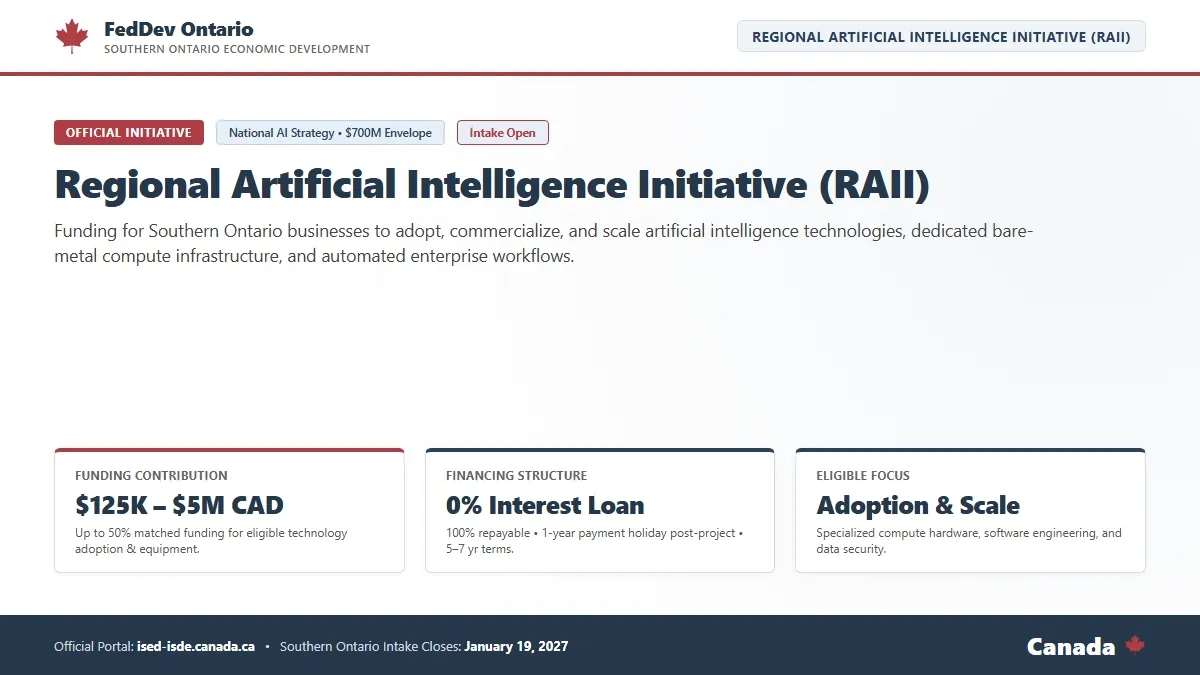
Abstract — In late 2026, the Government of Canada formally launched the expanded $700 Million Regional Artificial Intelligence Initiative (RAII) under Innovation, Science and Economic Development Canada (ISED), delivered across Southern Ontario by FedDev Ontario. While public attention frequently gravitates toward consumer chat tools and multitrillion-dollar foreign hyperscalers, this federal program represents the most substantial non-dilutive capital injection for domestic enterprise operational modernization in a generation. Providing 50% matched funding from $125,000 up to $5,000,000 CAD in the form of 100% interest-free, fully repayable contributions with a 12-month payment holiday, RAII creates a direct financial bridge for established Canadian enterprises to deploy private, on-premises artificial intelligence. This technical advisory examines the statutory mechanics of FedDev Ontario RAII, audits the strict eligibility thresholds (3-year operating history, TRL 6+ technology maturity, Annex C eligible cost schedules), and demonstrates how combining federal 0% interest loans with CRA SR&ED refundable tax credits and Class 50 capital cost allowances reduces the true net outlay of an enterprise sovereign AI installation to ~25% over a 7-year amortization schedule.
1. Where We Were: The Hidden Liabilities of Cloud AI for Canadian Business
Between 2023 and 2025, Canadian enterprises approached artificial intelligence primarily through rented seats on American public cloud platforms: OpenAI ChatGPT Enterprise, Microsoft Copilot, Anthropic Claude, and Salesforce Agentforce. While these services offered immediate browser-based access, they introduced three compounding structural liabilities that increasingly undermine corporate balance sheets:
The 3 Structural Liabilities of Rented Cloud AI
Cross-Border Data Leakage
Corporate queries route through American data centers. Subject to extraterritorial US CLOUD Act disclosure subpoenas and PIPEDA / Law 25 compliance liabilities.
Compounding USD SaaS Drag
Metered seats cost $30–$150 USD/user/month in depreciating foreign currency. Zero cap on annual vendor price increases creates compounding operating margin leaks.
Zero Capital Asset Ownership
All organizational context, fine-tuned weights, and custom workflow prompts remain captive in walled vendor gardens. Expensed as soft costs with $0 balance sheet equity.
1.1 The Cross-Border Data Residency Trap
Under Canadian statutory privacy frameworks—including the federal Personal Information Protection and Electronic Documents Act (PIPEDA), Ontario healthcare sector standards, and Quebec's Law 25—organizations maintain strict legal custodianship over client records, personal identifiable information (PII), and proprietary financial ledgers.
When employees query public cloud LLMs, prompts and embedded documents are routed into foreign data center clusters (us-east-1 in Northern Virginia, us-central1 in Iowa). This cross-border transfer subjects sensitive Canadian corporate assets to the jurisdiction of the US CLOUD Act (Clarifying Lawful Overseas Use of Data Act), allowing foreign authorities to compel data disclosure without Canadian judicial oversight.
1.2 The Perpetual SaaS Rent Tax
Commercial cloud providers price enterprise intelligence on a metered, per-seat recurring model. For an established Southern Ontario firm with 40 to 100 knowledge workers, cloud AI subscriptions quickly accumulate to $3,000–$12,000 USD per month ($48,000–$192,000 CAD annually) in permanent operating overhead. Because these payments are expensed as operational software leases, they build zero tangible corporate equity and leave the organization perpetually dependent on unilateral pricing revisions by foreign vendors.
2. Where We Are: The Statutory Architecture of FedDev Ontario RAII
To counteract these vulnerabilities and keep high-value intellectual property anchored within domestic borders, the federal government structured the Regional Artificial Intelligence Initiative (RAII) to finance physical digital infrastructure and domestic technical capacity.
FedDev Ontario RAII Allocation Architecture
AI Adoption
For established Southern Ontario businesses deploying sovereign AI into daily operations.
Commercialization & Scale-Up
For domestic AI technology firms developing novel algorithms and market products.
Ecosystem Enablement
For non-profit regional innovation hubs, BIAs, and academic accelerators.
2.1 The Core Financial Rules & Timelines
| Parameter | Statutory Requirement | Operational Strategic Meaning |
|---|---|---|
| Administering Body | Federal Economic Development Agency for Southern Ontario (FedDev Ontario) | Regional jurisdiction covering Windsor, London, Kitchener-Waterloo, Hamilton, Toronto/GTA, Kingston, and Ottawa. |
| Minimum Project Scope | $250,000 CAD Total Budget | FedDev requires a minimum contribution request of $125,000 CAD (50%), establishing a $250,000 project floor. |
| Maximum Project Scope | Up to $5,000,000 CAD FedDev Contribution | Supports multi-node deployments, on-premise inference clusters, and enterprise ERP integrations. |
| Financing Structure | 100% Fully Repayable, Interest-Free Contribution | Operates as a 0% interest loan from the Government of Canada. |
| Payment Holiday | 1 Year Post-Project Completion | The enterprise makes $0 in principal payments during the entire multi-month project build plus 12 months after completion. |
| Repayment Term | 5 to 7 Years (60 to 84 Equal Monthly Payments) | Principal-only amortization (e.g. $125,000 over 7 years = ~$1,488.10/month with zero interest charges). |
| Early Consideration Cutoff | November 24, 2026 | Priority processing window for projects initiating eligible expenses prior to March 31, 2027. |
| Final Statutory Intake Cutoff | January 19, 2027 at 4:59 PM EST | Final application deadline for this federal intake cohort. |
3. Strict Corporate Eligibility & The Technology Readiness Level (TRL) Threshold
FedDev Ontario enforces rigorous qualification filters to ensure capital is disbursed exclusively to viable Canadian operating entities with proven software readiness.
The 3 Mandatory Applicant Qualification Gates
3+ Years Active Operations
Legally incorporated and operating in Southern Ontario for a minimum of 36 consecutive months.
1+ Full-Time Equivalent (FTE)
Must maintain at least one worker on active corporate payroll within Southern Ontario.
Confirmed 50% Match
Must prove capability to fund the 50% matching share ($125k+ floor) through non-government funds.
3.1 The Three Corporate Gates
- Operating Longevity: The applicant must have been legally incorporated and actively trading for at least three full years in Southern Ontario. Paper holding companies, pre-revenue shells, or newly registered ventures without 36 months of tax filings are disqualified.
- Headcount: The business must employ at least one full-time equivalent worker on official payroll.
- Verified Matching Capital: The applicant must prove within 30 days of approval that they possess their 50% matching share ($125,000+) in unencumbered cash balances, an active commercial operating line of credit, or secured term financing.
3.2 The Technology Readiness Level (TRL 6+) Requirement
FedDev Ontario evaluates all applications under the standardized Government of Canada 9-level Technology Readiness Level scale:
| TRL Level | Federal Definition | RAII Eligibility Status |
|---|---|---|
| TRL 1–3 | Basic principles observed, technology concept formulated, analytical lab studies. | ❌ Strictly Ineligible (Fundamental academic research). |
| TRL 4–5 | Component validation in laboratory or simulated operational environment. | ❌ Strictly Ineligible (Unproven experimental software). |
| TRL 6 | System/subsystem model or prototype demonstration in a relevant environment. | ✅ Minimum Mandatory Statutory Threshold. |
| TRL 7 | Prototype demonstration in an operational environment (live field trials). | ⭐ Protoss / Kairos Field-Hardened Baseline. |
| TRL 8 | Actual system completed and qualified through test and demonstration. | ⭐ Protoss Turnkey Bare-Metal Dev Appliance. |
| TRL 9 | Actual system proven in operational environment through competitive commercial deployment. | Production-grade mission-critical operations. |
[!IMPORTANT]
The TRL Nuance for Adopting Businesses: An adopting enterprise does not have to develop artificial intelligence algorithms from scratch. Under the AI Adoption Stream, the mandate is that the technology platform being integrated must already operate at TRL 6 or higher. Because Protoss architectures and Kairos Agent run as live, field-tested systems—validated over cellular mesh, local vector databases, and multi-session IDE execution—engagements comfortably satisfy TRL 7/8 scoring criteria.
4. Eligible vs. Ineligible Costs (FedDev Annex C Breakdown)
Understanding what FedDev Ontario permits on project budgets is critical to drafting an audit-proof application.
100% Eligible Project Costs (50% Reimbursed by FedDev)
Specialized Computing Hardware
Dedicated bare-metal servers, on-premises enterprise GPU nodes, local NVMe storage arrays, and network switches.
Professional & Technical Services
External engineering fees for systems architecture, proprietary pipeline construction, and custom model integration.
Direct Implementation Labour
Portion of internal technical employee salaries strictly dedicated to deploying, testing, and training the new AI platform.
System Software & Database Licenses
Commercial vector database licenses, offline orchestration harnesses, and specialized developer runtime tooling.
Cybersecurity, Data Governance & Regulatory Audits
Third-party penetration testing, air-gap verification audits, cryptographic key management, and statutory privacy sign-offs.
4.1 How Bare-Metal Hardware Qualifies
Unlike cloud SaaS subscription meters, which are classified as routine operating expenses, physical on-premises servers (e.g. Kairos Bare-Metal Dev Appliances) are classified under Annex C: Machinery, Equipment, and Specialized Digital Infrastructure. This classification allows enterprises to allocate 40%–60% of their total project budget directly to purchasing owned physical silicon, which FedDev funds at 50% with zero interest.
4.2 Ineligible Expenditures
FedDev Ontario strictly disallows:
- Acquisition of commercial land or existing buildings.
- Debt refinancing or repayment of prior operational credit facilities.
- Routine, ongoing day-to-day administrative overhead.
- Standard recurring monthly subscriptions to third-party public cloud services.
5. The Triple-Stack Financial Engine: True Cost Analysis
The true financial power of FedDev Ontario RAII emerges when it is combined with federal and provincial tax incentives. By mathematically layering RAII with CRA SR&ED refundable tax credits and the CRA Class 50 Accelerated Investment Incentive, an enterprise's net capital outlay drops to a fraction of the gross scope.
The Triple-Stack Financial Engine: True Cost Analysis
Enterprise Sovereign AI Transformation
Turnkey On-Premises Hardware Cluster + Custom Vector Pipelines
Zero Balance Sheet Penalty: The elimination of recurring US dollar cloud subscriptions completely offsets the federal loan repayment, placing the client into positive monthly cashflow immediately upon deployment.
5.1 The Mathematical Model on a $250,000 Enterprise Deployment
Gross Turnkey Project Budget:                    $250,000.00 CAD
----------------------------------------------------------------
1. FedDev Ontario RAII Contribution (50%):     - $125,000.00 CAD  (0% interest, 12-mo grace period)
2. CRA SR&ED + Ontario OITC Refundable Credit: - $ 43,750.00 CAD  (35% net on $125k eligible technical R&D)
3. CRA Class 50 CCA 100% First-Year Write-Off:  - $ 18,550.00 CAD  (Shields $70k hardware @ 26.5% corp rate)
----------------------------------------------------------------
Net Effective Corporate Outlay:                  $ 62,700.00 CAD
================================================================
Client Amortization (FedDev Repayment, 7 yrs):    $  1,488.10 CAD / month (0% interest principal)
Average Monthly Rented SaaS Eliminated:         - $  3,500.00 CAD / month (OpenAI, Copilot, Salesforce)
----------------------------------------------------------------
NET MONTHLY CASHFLOW IMPACT:                    + $  2,011.90 CAD / month (IMMEDIATELY CASHFLOW ACCRETIVE)
By structuring the deployment on bare-metal silicon, the client does not merely "save money"—the modernization is net cashflow positive from the date of final commissioning. The $3,500/month previously burned on USD cloud subscriptions exceeds the $1,488.10/month interest-free repayment to Ottawa, generating over $2,000/month in net operational savings.
6. Where We Are Going: The 3-Step Engagement Architecture
To eliminate bureaucratic friction, Protoss deploys a streamlined three-phase delivery model that bridges technical architecture with federal compliance:
The 3-Step Delivery & Funding Architecture
Sovereign Feasibility Audit
A high-efficiency diagnostic reviewing corporate incorporation longevity, payroll headcounts, and monthly USD SaaS burn.
- • Verify 3-year operating history
- • Confirm $125k matching capability
- • Output: Statutory Eligibility Score
Working Prototype & Conditional SOW
Live proof-of-concept demonstration on client's anonymized schemas, proving sub-50ms search and custom agentic workflows.
- • Live TRL 7 demo in operational mesh
- • Turnkey Annex C budget & schedule
- • Conditional SOW: $0 if grant unapproved
Bare-Metal Deployment & Capital Match
Physical commissioning of on-premise compute nodes, local vector storage, and seamless cutover from foreign cloud subscriptions.
- • Dedicated hardware delivered & racked
- • Full data ingestion & pipeline cutover
- • Milestone FedDev disbursement claim
6.1 Step 1: The Sovereign Feasibility Audit
- A 15-minute diagnostic session reviewing corporate incorporation status, employee count, and current monthly software expenditures.
- Generates an immediate statutory eligibility scorecard detailing exact matching potential under FedDev Ontario guidelines.
6.2 Step 2: Working Prototype & Conditional SOW
- Demonstrated TRL 7: Protoss spins up an on-premises Kairos node demonstrating private search, automated intake, and agentic workflows using the client's anonymized schemas.
- Conditional SOW: The client executes a formal Statement of Work that is 100% contingent on FedDev approval. If the federal contribution is granted, the project proceeds; if declined, the client incurs zero financial obligation.
6.3 Step 3: Turnkey Deployment & Commissioning
- Delivery of dedicated bare-metal server hardware.
- Local deployment of LanceDB vector memory, sub-50ms reflex intent routing, and PIPEDA-compliant audit trails.
- Formal submission of milestone completion documentation to FedDev Ontario for contribution disbursement.
7. Actionable Next Steps & Deadlines
With the November 24, 2026 early consideration deadline approaching, enterprises looking to commence expenditures prior to March 31, 2027, must assemble technical project scopes immediately.
- Audit Your Eligibility: Southern Ontario business operators can test their funding qualification through our interactive calculator:
👉 protoss.ca/raii#calculator - Schedule a Technical Systems Scoping Call: Book a complimentary 15-minute consultation to review your technical architecture and receive a customized FedDev Annex C budget template:
👉 protoss.ca/raii
Protoss Sovereign Tech — Engineering Digital Independence.
Canonical Reference: CANADIAN_AI_GRANTS_AND_RAII_MASTER_REFERENCE.md